
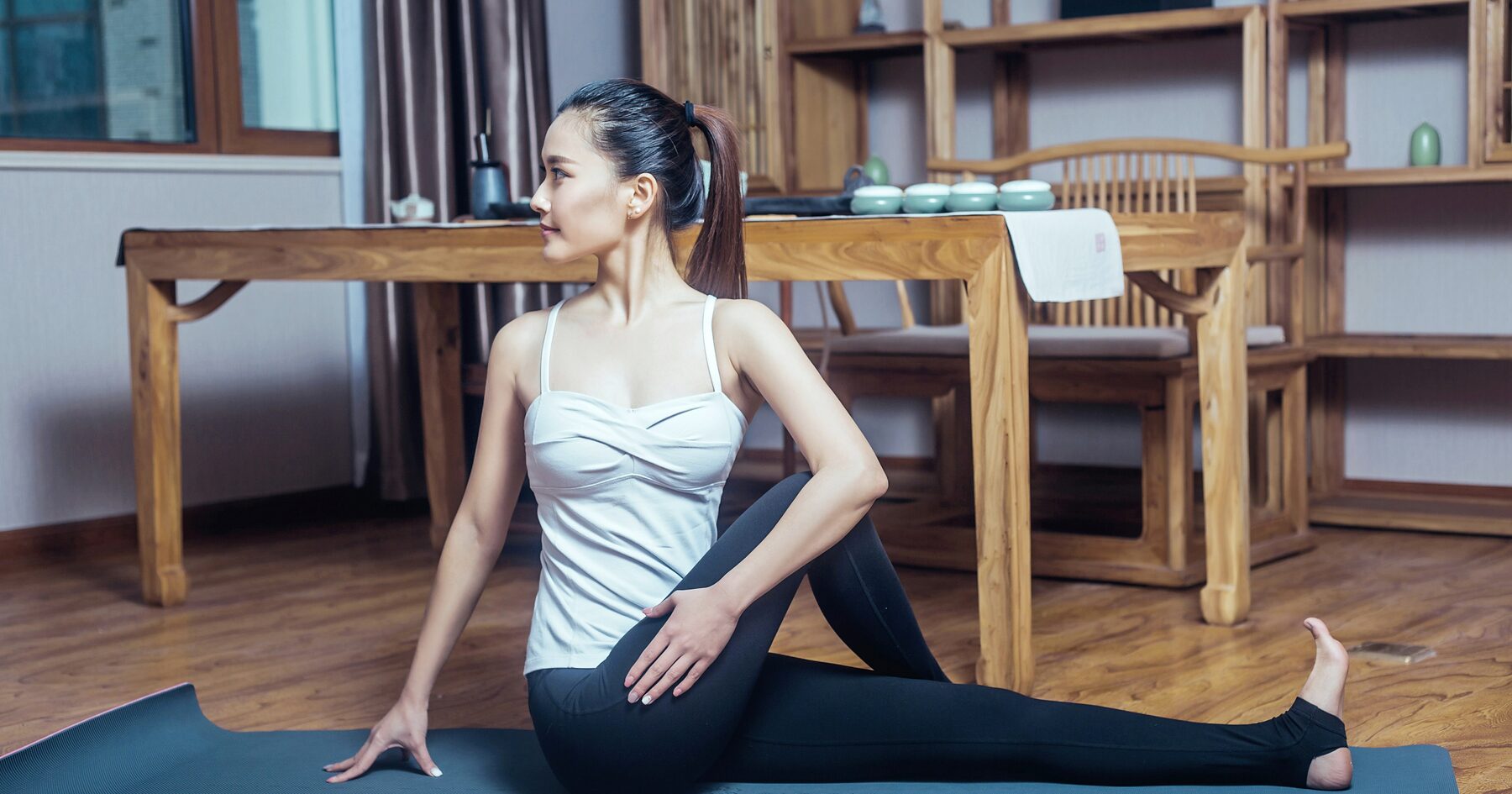
This won’t fix your sleep — the trials on that are thin and the reviewers say so. It will get the day out of your hips in ten minutes, with no equipment.
The short answer
Two warm-ups, four holds, one finish. Ten minutes.
The American College of Sports Medicine puts a static hold at 10–30 seconds, 2–4 repetitions, roughly 60 seconds total per muscle group — the 60–90 second holds all over the internet aren’t better, just longer. And the limit: of 16 stretching trials in people with sleep disorders, only 5 reported a significant improvement.
Key takeaways
- Holding past 30 seconds isn’t better for most adults. The only longer number in the guidance is 30–60 seconds for older people.
- What changes in the first weeks is stretch tolerance, not muscle length.
- Stretching barely touches next-day soreness: about one point on a 100-point scale across 12 trials.
- Evening movement doesn’t wreck sleep. Across 23 studies, only vigorous work ending within an hour of bed did.
- Two to three days a week is the floor. Daily gets you more.
The routine
Floor, a wall, a doorway. Go in this order — cold tissue takes the sensation badly, so the warm-ups aren’t optional.
| Move | What you do | Time |
|---|---|---|
| 1. Shoulder rolls, then neck tilts | Five slow rolls back, five forward. Then ear toward shoulder, both sides — let the weight of your head do it, no pulling. | 60 sec |
| 2. Cat-cow | Hands and knees. Arch as you breathe in, round as you breathe out. Eight to ten slow cycles. | 60 sec |
| 3. Figure-four | On your back, right ankle across the left knee. Reach through and pull the left thigh in. Right hip and glute. | 30 sec each side |
| 4. Half-kneeling hip flexor | Back knee down, front foot forward. Tuck the pelvis under first, then shift an inch forward. Feel it in your lower back? You skipped the tuck. | 30 sec each side |
| 5. Seated forward fold | Legs out, knees soft. Hinge from the hips, not the spine. Reach for your shins and stop there. | 30 sec, twice |
| 6. Doorway hamstring | Hips at the doorframe, one leg up the frame, the other flat through the doorway. Gravity does the work. | 30 sec each side |
| 7. Legs up the wall | Hips a few inches off the wall, legs against it, arms out. In for four counts, out for six. | 3–5 min |
Why 30 seconds and not 90
The flexibility guidance is 10–30 seconds per hold, 2–4 repetitions, about 60 seconds total per muscle group, at least two or three days a week. Older adults are the exception: 30–60 seconds per hold.
So the sequence above gets each muscle group to about half that 60-second target. Deliberately — it’s a wind-down, not a session. Want the range of motion too? Run moves 3 to 6 twice. The second round is where the guideline lands.
What stretching changes, and what it doesn’t
A 2010 review in Physical Therapy asked what actually happens when people get more flexible. Muscle does lengthen under stretch, but transiently. For a single session and for 3-to-8-week programmes the evidence pointed to modified sensation instead: you tolerate more, so you move further. Past eight weeks has not been evaluated.
That reframes the goal. You’re not lengthening tissue at 10pm — you’re lowering the guard on positions your body spent nine hours avoiding. A fine reason to do it, just not the one on the label.
If you stretch to head off tomorrow’s soreness, here’s the number you’re buying. A Cochrane review of 12 trials — one a field study of 2,377 people — found stretching beforehand cut next-day soreness by half a point on a 100-point scale, afterwards by about one point. The verdict: no clinically important reduction. Stretch because stiff hips are unpleasant, not as insurance.
Does it help you sleep?
Less than the wellness copy implies. A 2024 scoping review pooled 16 studies of stretch training in people with sleep disorders — 1,281 participants, mean age 58. Weighted averages trended positive, but only 5 of the 16 found a significant improvement, and the authors concluded the evidence is slight.
The timing is at least safe: across 23 studies, evening exercise didn’t harm sleep. What moves sleep onset is light, core temperature and arousal — covered here.
Who should modify or skip this
- Sharp pain, numbness or tingling down a leg. Stop — that’s a nerve conversation with a provider, not a hamstring.
- Recent surgery or a replaced joint. Hip and knee replacements carry movement restrictions for months. Ask which positions are off the list.
- Pregnancy. Ligaments are laxer than usual and end-range holds are easy to overshoot. Stay well short, and skip lying flat on your back later on.
- Hypermobility. If you already reach further than most people, more range isn’t the goal — stability is.
- If stiffness has lasted weeks and is worsening, that’s a provider. Desk-related pain has its own guide.
Before you buy anything
Do the free things first: this needs a floor and a doorway. Mats, blocks, straps, foam rollers and supplements all sit downstream of showing up four nights a week.
If your evenings are stiff because your days are still, the fix is earlier than 10pm — see movement breaks at work.
Questions people ask
I stretch every night and still feel tight. What am I missing?
Tightness often isn’t short muscle — it’s a joint held in one position all day, or a muscle working overtime to stabilise something. More stretching doesn’t fix that — changing the position and loading the area does. Start with the mobility guide.
Does it have to be before bed?
No. Nothing in the flexibility guidance is time-of-day specific. Evening is convenient and it’s when you’re warmest — do it whenever you actually will.
Should it hurt?
A firm pull, not a sharp one. Since early gains are tolerance rather than length, chasing sharp sensation buys nothing and makes you skip tomorrow.
Before or after a shower?
After — warm tissue takes the sensation better. If the shower is also your sleep cue, finish it one to two hours before lights out, then stretch.
Sources
- Quantity and Quality of Exercise for Developing and Maintaining Fitness in Apparently Healthy Adults — ACSM position stand, Med Sci Sports Exerc, 2011;43(7):1334–1359.
- A scoping review of the effect of chronic stretch training on sleep quality in people with sleep disorders — European Journal of Applied Physiology, 2024;124(9):2533–2545.
- Increasing Muscle Extensibility: A Matter of Increasing Length or Modifying Sensation? — Physical Therapy, 2010;90(3):438–449.
- Stretching to prevent or reduce muscle soreness after exercise — Cochrane Database of Systematic Reviews, 2011, Art. No. CD004577.
- Effects of Evening Exercise on Sleep in Healthy Participants — Sports Medicine, 2019;49:269–287.
How we make money. Some links on this page are affiliate links. If you buy through one, we may earn a commission at no extra cost to you. It does not change what we write — see our affiliate disclosure.
These statements have not been evaluated by the Food and Drug Administration. CBD products are not intended to diagnose, treat, cure or prevent any disease. Serene Leaf does not physically test products; our assessments are based on published research, third-party lab reports and publicly available product information.
This article is information, not medical advice. Talk to a qualified healthcare provider before starting any supplement — especially if you are pregnant, nursing, taking medication or managing a diagnosed condition. 21+ only.