
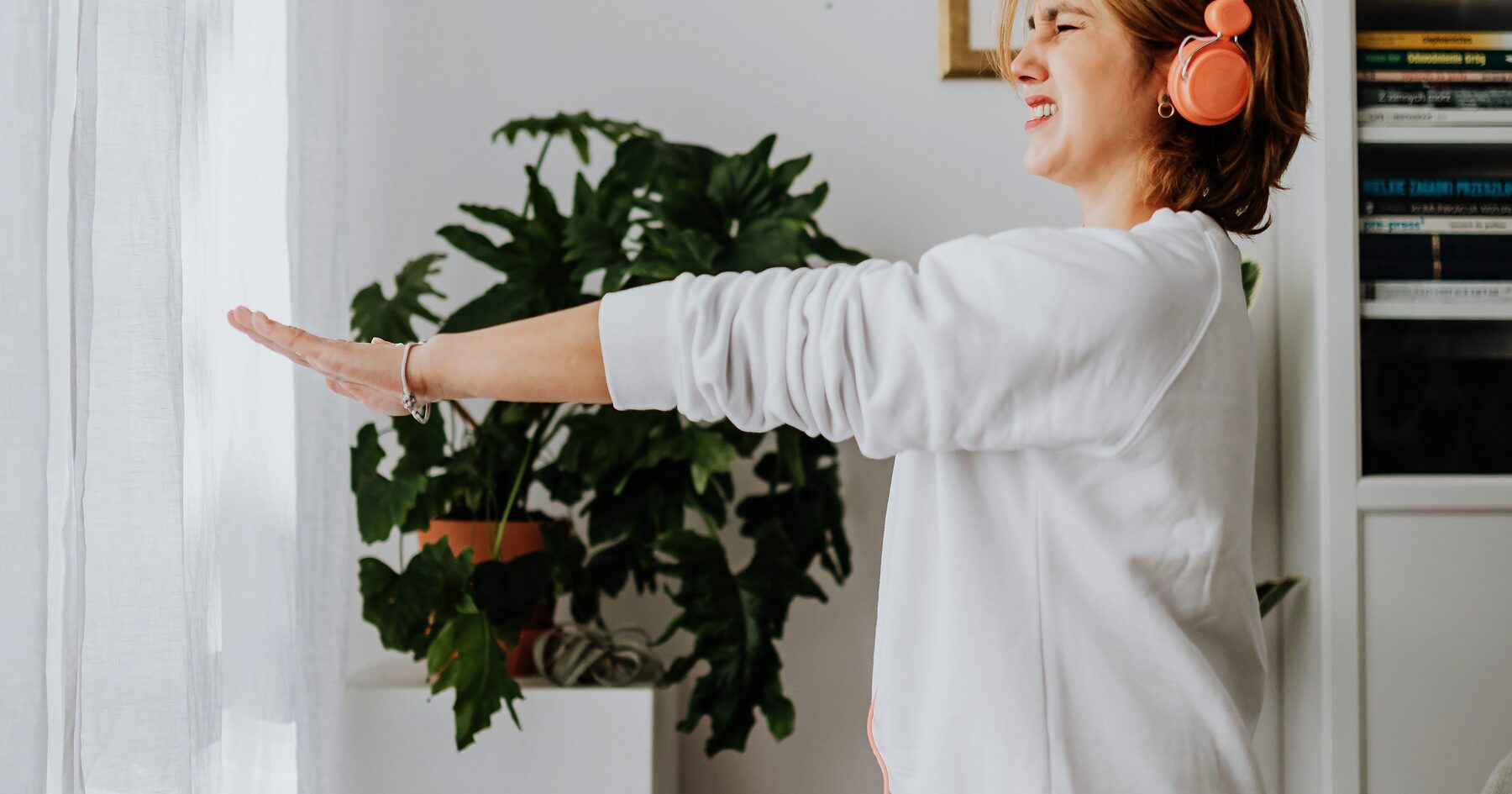
Nothing below needs a mat, a change of clothes or standing up. It also won’t fix a neck that’s ached for months — stretching alone has a poor record there, and what worked in the trials was something else.
The short answer
Eight seated moves. Ten to twenty seconds each.
Canadian workplace-ergonomics guidance puts a workstation stretch at 10–20 seconds, repeated three times, inside a 5–10 minute break every hour. The honest limit: in the one Cochrane review to test extra rest breaks — 15 trials, 2,165 office workers — less neck, shoulder and wrist discomfort showed up only in data-entry staff, on evidence graded very low quality.
Key takeaways
- Both forearm directions matter: palm-up loads the flexors, palm-down the extensors. Doing one and skipping the other is the common miss.
- Across 15 cross-sectional studies, adults with neck pain held the head about 4.8° further forward than adults without it. In adolescents the difference disappeared — and cross-sectional means nobody knows which came first.
- Two of the eight are repetitions, not holds: 10 shoulder rolls each direction, 5–10 head glides.
- A firm pull, never a sharp one, and no bouncing. Breathe normally instead of holding your breath.
The eight-move sequence
Run it top to bottom — about five minutes, all of it from the chair. The order works down the body, so you’re not twisting a cold spine in move two.
| Move | What you do | Dose |
|---|---|---|
| 1. Shoulder rolls | Roll both shoulders backward in big slow circles, then forward. Smooth, no shrugging into the ears. | 10 each direction |
| 2. Neck side bend | Sit tall. Tilt the right ear toward the right shoulder until the left side of the neck pulls. Rest that hand on your head for its weight only — no pulling. | 10–20 sec each side |
| 3. Head glide | Eyes level, slide the head straight back over your shoulders — a deliberate double chin. Nothing tilts. | 5–10 reps |
| 4. Chest opener | Draw the shoulder blades back and down, opening the front of the shoulders. Hands behind the head, or fingers laced behind your back if the chair is in the way. | 10–20 sec |
| 5. Seated twist | Both feet flat. Right hand outside the left thigh, rotate the torso left. Turn from the ribs — the neck follows, it doesn’t lead. | 10–20 sec each side |
| 6. Wrist flexor, then extensor | Arm out, palm up: draw the fingers back toward you. Then palm down, fingers hanging: draw the back of the hand toward you. | 10–20 sec each, both arms |
| 7. Seated figure-four | Right ankle across the left knee so the legs make a 4. Chest lifted, then hinge forward from the hips an inch. Right glute and outer hip. | 10–20 sec each side |
| 8. Hamstring, then ankle circles | Slide to the front of the seat, one leg straight, heel down and toes up. Hinge from the hips, not the spine. Then circle that ankle. | 10–20 sec, 5 circles each way |
The table is one pass; CCOHS repeats most workstation stretches three times. If your stiffness is specific — usually the neck or the wrists — repeat those two and leave the rest alone.
General flexibility guidance asks for longer holds and more repetitions than any of this. That’s a dedicated session, laid out in our evening stretching routine. Don’t try to hit it at a desk. You’ll do it twice and stop.
The one worth standing for
The figure-four gets the back of the hip. Nothing seated gets the front of it, because sitting is the position you’d be stretching out of.
So: stand, step one foot back into a short staggered stance, tuck the pelvis under first, then shift forward an inch. Ten to twenty seconds a side. Getting up is the point anyway — how often, and for how long.
The Cochrane review of exercise for mechanical neck disorders pooled 27 trials and 2,485 participants. Its verdict on stretching is one sentence: “when only stretching exercises were used no beneficial effects may be expected.” What moved the needle was strengthening and endurance work for the neck, shoulder and shoulder-blade region — moderate-quality evidence, in a review that found no high-quality evidence for anything. Desk stretches are comfort. Strength is the part that changed outcomes.
What a desk actually does to you
The head-forward thing is measurable. That 2019 meta-analysis also found posture correlated with pain intensity at r = −0.55 in adults and with disability at r = −0.42. In adolescents the mean difference was −1.05°, its confidence interval straddling zero.
Every one of those 15 studies was a snapshot, so the posture could as easily be a response to the pain as its cause. A reason to change position often. Not a verdict on your spine.
The hips are murkier. Sitting holds the hip near 90° for hours, which is why standing feels like unfolding — but whether that shortens tissue or just makes the end range unfamiliar is a question flexibility research hasn’t closed. Our evening routine covers what actually changes.
Who should modify or skip this
- Numbness, tingling or shooting pain down an arm or leg. Stop. That’s a nerve, and a provider conversation.
- Dizziness with neck movement. Skip the head-turning moves and get it looked at.
- Recent surgery, a replaced joint, a known disc problem. Ask which positions are off the list first.
- Pregnancy. Ligaments are laxer than usual, so end-range holds overshoot easily. Stay well short of your normal limit.
- An ache lasting weeks and worsening is the wrong job for a stretch. See neck and back pain from sitting, then a clinician.
Before you buy anything
Do the free things first. This needs the chair you already own. Lumbar cushions, massage guns, posture braces and the $600 chair all sit downstream of getting up once an hour.
Standing desks are the one to watch. In the Cochrane ergonomics review, sit-stand workstations and workstation adjustment made no difference to upper-limb pain or discomfort against no intervention at all. They help you sit less — that’s worth something, just not what the marketing sells.
Questions people ask
How do I do these in an open-plan office without looking strange?
Moves 2, 3, 5 and 6 are invisible from two desks away — a head tilt, a chin tuck, a twist, a hand on a wrist. The figure-four reads as crossing your legs. If it still feels conspicuous, run those four at the desk and save the rest for the walk back from the kitchen.
My neck has hurt for months. Will these help?
Probably not much on their own. The Cochrane evidence points at strengthening the neck, shoulder and shoulder-blade muscles rather than stretching them — and found no high-quality evidence in either direction. Use these for daytime comfort; take the persistent pain to a physiotherapist.
Do I have to do all eight?
No. Frequency beats completeness at a desk. Two moves eight times a day does more for how you feel at 4pm than eight moves once.
Is this enough for wrists, if I type all day?
The forearm stretches ease the tight-and-achy feeling. Pain with numbness in the thumb, index and middle fingers — or pain that wakes you at night — needs a provider. And the Cochrane review’s only moderate-quality upper-limb finding involved arm supports plus an alternative mouse: a kit change, not a stretch.
Sources
- Office Ergonomics: Stretching at the Workstation — Canadian Centre for Occupational Health and Safety, OSH Answers.
- Exercises for mechanical neck disorders — Cochrane Database of Systematic Reviews, 2015, Art. No. CD004250.pub5.
- Ergonomic interventions for work-related musculoskeletal disorders of the upper limb and neck among office workers — Cochrane Database of Systematic Reviews, 2018, Art. No. CD008570.pub3.
- The Relationship Between Forward Head Posture and Neck Pain: a Systematic Review and Meta-Analysis — Current Reviews in Musculoskeletal Medicine, 2019;12(4):562–577.
How we make money. Some links on this page are affiliate links. If you buy through one, we may earn a commission at no extra cost to you. It does not change what we write — see our affiliate disclosure.
These statements have not been evaluated by the Food and Drug Administration. CBD products are not intended to diagnose, treat, cure or prevent any disease. Serene Leaf does not physically test products; our assessments are based on published research, third-party lab reports and publicly available product information.
This article is information, not medical advice. Talk to a qualified healthcare provider before starting any supplement — especially if you are pregnant, nursing, taking medication or managing a diagnosed condition. 21+ only.