
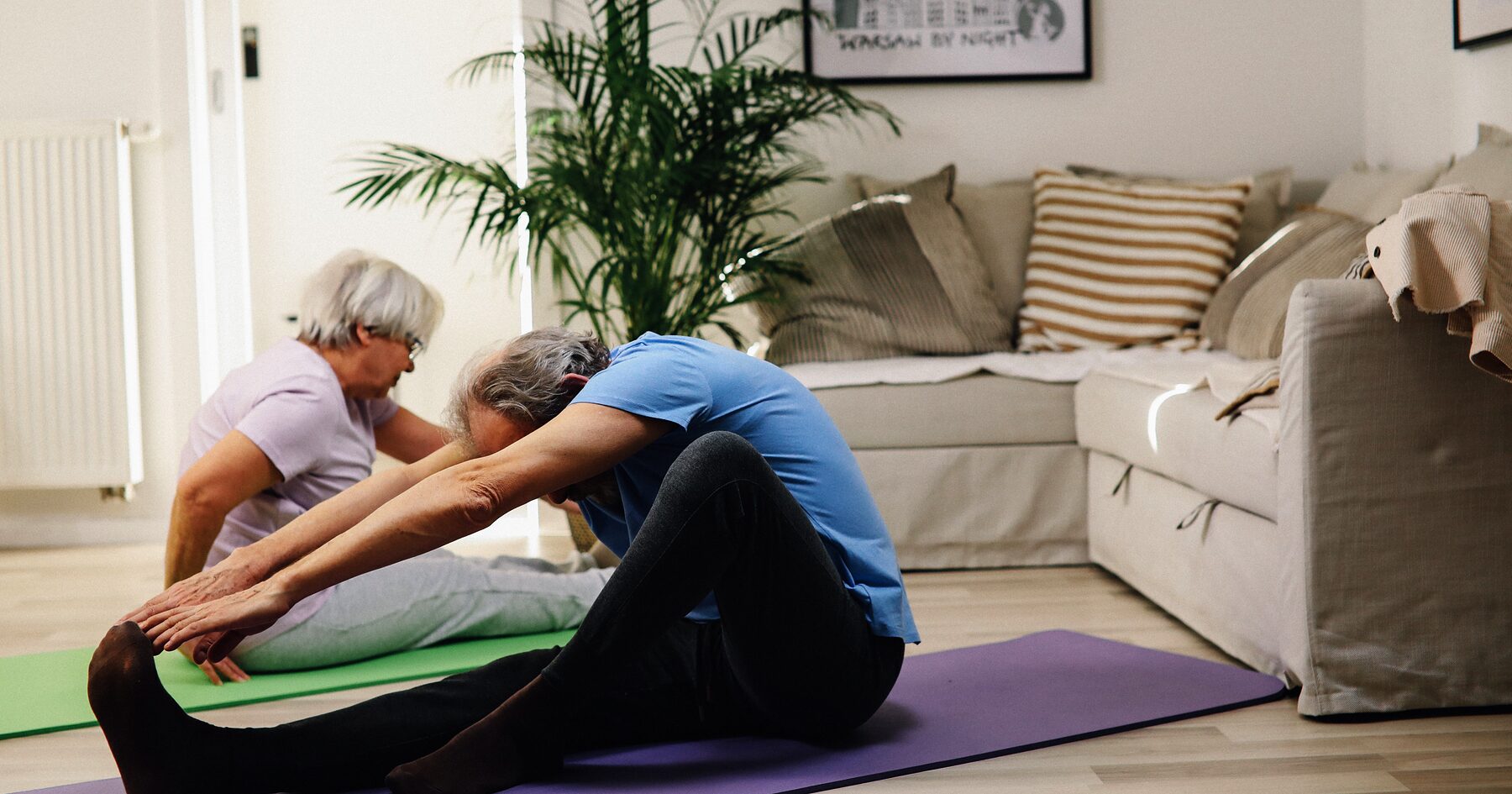
A weekend of yard work now costs you three days instead of one. What gets filed under “getting older” is at least three separate problems, and only two of them are yours to work on.
The short answer
Usually strength. Sometimes soreness. Occasionally a disease.
At 75, men lose 3–4% of their strength a year against 0.80–0.98% of their muscle mass — force drops two to five times faster than tissue. Resistance training moves that number: across 25 trials in 819 adults averaging 70 years old, the effect size for strength was 1.57. What it won’t touch is stiffness running past an hour most mornings, swollen joints, or several joints at once. That one is a referral, not a routine.
Key takeaways
- Older adults often report less soreness than younger ones after the same damaging exercise. What lags is force — muscle function took over 72 hours to fully recover in most studies.
- Soreness from unaccustomed work starts at 6–12 hours, peaks at 48–72, and clears within a week. Still there on day ten? It isn’t soreness.
- The dose behind the largest strength gains: two sessions a week, 2–3 sets, 7–9 reps, at 70–79% of a one-rep max.
- UK guidance says refer urgently if the small joints of hands or feet are involved, if more than one joint is involved, or if three months have passed — even with normal bloods and negative rheumatoid factor.
- For knee osteoarthritis, exercise came out 13.14 points better on a 0–100 pain scale across 56 trials. That is the biggest number on this page, and it costs nothing.
Three problems wearing one word
“Stiff and achy” covers things that behave nothing alike and need nothing alike. Find your row before you pick a routine.
| What it is | How it behaves | What it needs |
|---|---|---|
| Age-related strength loss | Everything is heavier — stairs, shopping, getting up off the floor. Feels stiff, isn’t swollen, loosens once you’re moving. | Load. Two sessions a week, at a weight that ends the set for you. |
| Soreness after unaccustomed work | Arrives 6–12 hours after the effort, worst at 48–72 hours, gone within a week. Tender when pressed. Not hot, not swollen. | Time, and a smaller jump next time. Nothing in a jar shortens it reliably. |
| Inflammatory joint disease | Morning stiffness past 30–60 minutes most days. Swelling, warmth, several joints, often the small ones in hands and feet. Loosens with movement, not with rest. | A diagnosis, urgently. Not a stretching routine and not a balm. |
If the third row is you, stop reading exercise advice and make the call. UK national guidance tells clinicians to refer urgently when the small joints of the hands or feet are affected, when more than one joint is affected, or when three months have already gone by — and to do it even with a normal acute-phase response and negative anti-CCP antibodies or rheumatoid factor.
Read that last clause twice. A normal blood panel is not reassurance when a joint is visibly swollen. The guideline is written as a clock because early is when it counts.
The one-hour rule is a trigger, not a test
You’ll see “stiffness over an hour means inflammatory arthritis” repeated everywhere. It’s a useful prompt and a poor test. Among 519 people with hand osteoarthritis, 24% had morning stiffness lasting 30–60 minutes and 17% had it running past an hour.
Prolonged stiffness doesn’t rule osteoarthritis in or out.
The “I’m sore for three days now” story doesn’t survive the data. A 2023 scoping review of 27 studies found several reporting significantly lower perceived soreness in older adults than in younger ones after the same damaging exercise, and others finding no age effect at all. What did lag was force: declines in muscle function peaked within 48 hours and took over 72 hours to fully recover. You aren’t hurting more than you used to. You’re producing less, for longer — a strength problem in a soreness costume.
What you’re actually losing
Not bulk. Force. A quantitative review in Frontiers in Physiology put numbers on both, and they don’t move together.
- Muscle mass at 75 falls by 0.80–0.98% a year in men and 0.64–0.70% in women.
- Strength at 75 falls by 3–4% a year in men and 2.5–3% in women.
- Studies that measured both in the same people report strength going two to five times faster than mass.
The review’s own conclusion is the line worth keeping: loss of strength is a more consistent risk for disability and death than loss of muscle mass.
The dose that produced the gains
A 2015 meta-analysis pooled 25 resistance-training studies in healthy older adults — 819 people, mean age 70.4 — and looked for the shape of the dose, not just whether it worked.
| Variable | Where the largest strength effect sat |
|---|---|
| Sessions per week | Two |
| Sets per exercise | Two to three |
| Reps per set | Seven to nine |
| Intensity | 70–79% of a one-rep max |
| Programme length | 50–53 weeks — the effects kept building for about a year |
| Overall effect on strength | 1.57 across all 25 studies |
Two sessions. Not five. But 7–9 reps at 70–79% of a one-rep max is not gentle — it’s the last rep genuinely being the last one you had. That’s the part most “mobility for seniors” content quietly drops.
Layered on top, the US physical activity guideline asks for 150–300 minutes of moderate aerobic activity a week plus muscle-strengthening on two or more days covering all the major muscle groups. Older adults get one addition: balance training, as part of multicomponent activity. And if a chronic condition makes 150 minutes impossible, the guideline says be as active as your abilities and conditions allow — the floor is not zero.
If it’s your knees
Osteoarthritis is neither of the first two rows, and it’s the one people most often decide to rest. Cochrane updated the knee evidence in 2024: 139 trials, 12,468 participants.
Against usual care or no programme, exercise came out 13.14 points better on a 0–100 pain scale (95% CI 10.36–15.91; 56 studies, 4,184 people) and 12.53 points better on physical function (95% CI 9.74–15.31; 54 studies, 4,352 people), on moderate-certainty evidence.
Thirteen points out of a hundred is not a miracle. It is also more than any jar, patch or supplement in this category has ever shown, and the whole thing is free. Our movement and mobility guide covers where to start if the floor feels a long way down.
Heat, cold, and what’s in the balm
Heat is cheap, pleasant and short-acting. The 2024 review of unaccustomed-exercise soreness reached no uniform conclusion on whether cold or heat performs better on pain, which is roughly where the evidence has sat for years. Use whichever you’ll actually use.
Menthol rubs are counter-irritants: the cooling sensation is the mechanism, and it fades. Hemp balms are marketed harder and tested less. The largest test — 320 people, 12 weeks, 250 mg or 500 mg a day of transdermal CBD gel for knee osteoarthritis — did not separate from placebo on its primary endpoint, the weekly mean of 24-hour average worst pain at week 12. Our CBD for muscle recovery guide has the rest.
And sleep does more of this work than any of it. Sleep and muscle recovery is the version with the research in it.
Who should not reach for a topical
- Anyone on prescription medication. CBD competes for the cytochrome P450 enzymes that clear blood thinners, some antidepressants and seizure drugs — a live concern at an age when most people take something. Ask your provider first.
- Pregnant or nursing. Don’t.
- Broken skin, a rash, or a hot swollen joint. Topicals go on intact skin, and a hot joint is row three, not a sore spot.
- Anyone subject to drug testing. Full-spectrum products carry trace THC (≤0.3%).
- Anyone whose stiffness has lasted weeks, or runs past an hour each morning. That’s a provider, not a supplement.
Before you buy anything
Do the free things first, and here the free things are also the ones with the biggest numbers. Two strength sessions a week at a weight that ends the set. Walking on most days. Balance work, because that’s the one the guideline adds for a reason.
Only then is a topical worth a conversation, and only as comfort on a rough morning. If your days are still and that’s why the mornings are stiff, start further upstream — movement breaks at work, an evening stretching routine, or the desk pain guide if it’s mostly neck and back.
Questions people ask
I’m in my sixties with a sore knee. Is loading it actually safe?
That is what 139 trials and 12,468 people with knee osteoarthritis did, and exercise came out 13.14 points better on a 0–100 pain scale than usual care. The resistance-training trials averaged 70 years old. Start well below 70% of a one-rep max, add slowly, and take new swelling, locking or giving-way to a provider before you carry on.
My blood tests came back normal. Does that settle it?
No. UK guidance tells clinicians to refer urgently even with a normal acute-phase response and negative anti-CCP antibodies or rheumatoid factor. Normal bloods rule out very little when a joint is swollen or several joints are stiff each morning.
How long should soreness last after a hard session?
Six to twelve hours to arrive, worst at 48–72, gone inside a week. Longer than that — or soreness with swelling, dark urine, or a joint that’s hot — is a different conversation and worth a same-day call.
Is stretching pointless, then?
No, just misfiled. It’s a change of position and it feels good, which is reason enough. It just isn’t the intervention carrying the numbers here — loading is. Do both if you like; don’t swap one for the other.
Am I too old to start?
The pooled trials averaged 70.4 years and produced an effect size of 1.57 for strength. The largest gains came from programmes running 50–53 weeks, so the honest answer is that the payoff is measured in a year, not a fortnight — and it starts accruing well before then.
Sources
- Sarcopenia, Dynapenia, and the Impact of Advancing Age on Human Skeletal Muscle Size and Strength; a Quantitative Review — Frontiers in Physiology, 2012;3:260.
- Dose–Response Relationships of Resistance Training in Healthy Old Adults: A Systematic Review and Meta-Analysis — Sports Medicine, 2015;45(12):1693–1720.
- Recovery from Resistance Exercise in Older Adults: A Systematic Scoping Review — Sports Medicine – Open, 2023;9:51.
- Delayed Onset Muscle Soreness (DOMS) – Muscle Biomechanics, Pathophysiology and Therapeutic Approaches — German Journal of Sports Medicine, 2024;75(5):189–194.
- Exercise for osteoarthritis of the knee — Cochrane Database of Systematic Reviews, 2024, Art. No. CD004376.
- Prolonged morning stiffness is common in hand OA and does not preclude a diagnosis of hand osteoarthritis — Osteoarthritis and Cartilage, 2022.
- Rheumatoid arthritis in adults: management (NG100) — National Institute for Health and Care Excellence, 2018 (amended 2020).
- Physical Activity Guidelines for Americans, 2nd edition — U.S. Department of Health and Human Services, 2018.
- Synthetic transdermal cannabidiol for knee pain due to osteoarthritis — Osteoarthritis and Cartilage, 2018;26(Suppl 1):S26.
How we make money. Some links on this page are affiliate links. If you buy through one, we may earn a commission at no extra cost to you. It does not change what we write — see our affiliate disclosure.
These statements have not been evaluated by the Food and Drug Administration. CBD products are not intended to diagnose, treat, cure or prevent any disease. Serene Leaf does not physically test products; our assessments are based on published research, third-party lab reports and publicly available product information.
This article is information, not medical advice. Talk to a qualified healthcare provider before starting any supplement — especially if you are pregnant, nursing, taking medication or managing a diagnosed condition. 21+ only.