
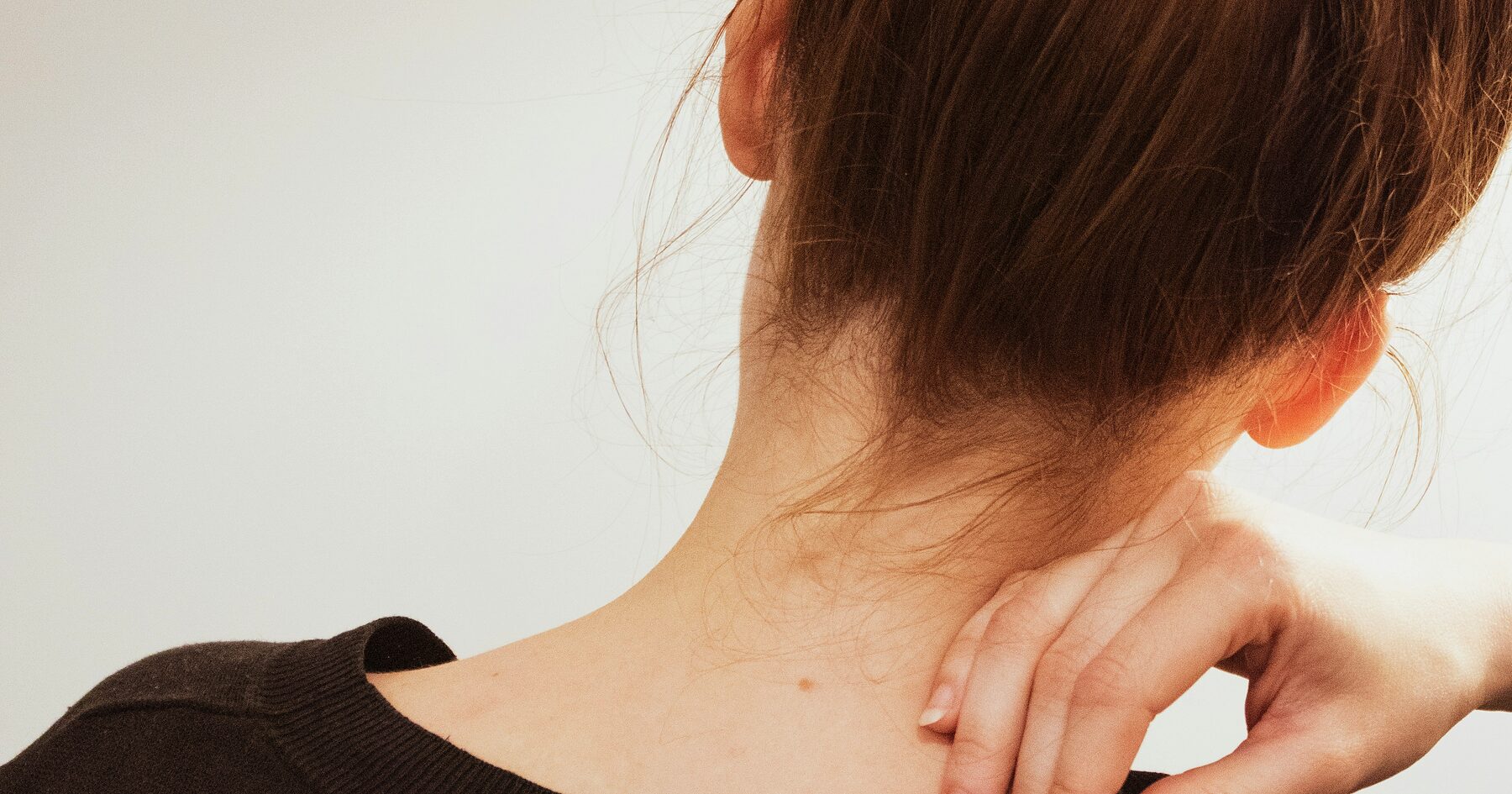
By 4pm your neck is stiff and you haven’t lifted anything heavier than a mug. The usual culprit — your posture — is the one part of this the research keeps failing to confirm.
The short answer
Not how you sit. How long you sit still.
In a six-month trial of 193 office workers, 17% of those prompted to take short breaks reported new neck pain, against 44% of those left alone. In a separate study of 1,108 seventeen-year-olds, how far the head sat forward made no difference to neck pain at all (P=.773). The variable everyone tries to correct is the one with the weakest link to the outcome.
Key takeaways
- A 2023 scoping review of 41 papers on “text neck” found no scientific evidence linking it to neck pain.
- In Cochrane’s office-ergonomics review, workstation adjustment and sit-stand desks showed no effect on upper-limb pain. An arm support with an alternative mouse was the only item with moderate-quality evidence (RR 0.52).
- The breaks in that trial averaged 3.1 minutes, about 32 times a day. Frequency was the variable, not duration.
- For chronic neck pain, strengthening the neck and shoulder blades carried the largest effect in Cochrane’s review (SMD −0.71) — larger than stretching them.
- Numbness, weakness or any new bladder change is not desk pain. That list is the part to read first.
First, the things that aren’t desk pain
Desk ache is dull, it wanders, and it loosens when you move. These don’t behave that way, and none is a stretching problem.
- Numbness or pins and needles in an arm, hand, leg or foot. That’s an appointment, today.
- Weakness — a foot that catches on a step, a grip that drops things. That’s an appointment, today.
- Pain that shoots below the knee, not just into the buttock. That’s an appointment, today.
- Any new bladder or bowel change — trouble starting, dribbling, not feeling the bladder fill — or numbness anywhere you’d sit on a saddle. That’s an appointment, today. UK national guidance now says a new bladder symptom alongside back pain warrants a same-day scan even when the examination looks normal.
- Pain that started after a fall, a crash or a heavy landing. That’s an appointment, today.
- Unexplained weight loss, fever, or a history of cancer alongside new back pain. That’s an appointment, today.
- Pain that wakes you, or that is worse lying down than standing up. That’s an appointment, today.
One caveat, honestly. A 2016 review of 16 national guidelines found most of these signs have never had their diagnostic accuracy tested; only “history of cancer” rests on acceptable validity. They’re over-inclusive by design. A wasted appointment costs an hour; a missed cauda equina costs far more.
Posture is the wrong suspect
Three serious attempts to link head position to neck pain. Three misses.
| Study | Who | What it found |
|---|---|---|
| Damasceno 2018 European Spine Journal | 150 adults aged 18–21, posture rated by physiotherapists and by the participants | No association with neck pain (OR 1.23, p=0.61) or with how often it recurred (OR 1.17, p=0.68) |
| Richards 2016 Physical Therapy | 1,108 Australian 17-year-olds, sorted into four measured posture clusters | No difference in the odds of persistent neck pain (P=.773) or headache (P=.563) |
| Grasser 2023 European Spine Journal | Scoping review of 41 papers using the term “text neck” | “No scientific evidence” linking text neck with neck pain, regardless of definition |
Grasser went further and asked researchers to stop calling any posture “incorrect” until something supports the word. Posture is the defining feature in 92.7% of published “text neck” definitions — and it’s the feature that doesn’t predict pain.
You’ll also meet a number: your head weighs about 12 pounds, and every inch it drifts forward adds ten more. We’ve left it out — the load may be real, but nobody has shown head position predicts who ends up hurting.
What did move the numbers
A 2021 trial took 193 office workers across six Bangkok organisations, all screened as high risk, and gave them a device that nudged. Three arms, six months, 96% follow-up.
| Group | New neck pain over 6 months | New low-back pain |
|---|---|---|
| Active breaks averaged 3.1 min, ~32×/day | 17% — HR 0.45 (95% CI 0.20–0.98) | 9% — HR 0.34 (0.12–0.98) |
| Postural shifts ~27 shifts per hour, stayed seated | 17% — HR 0.41 (95% CI 0.18–0.94) | 7% — HR 0.19 (0.06–0.66) |
| No prompt (control) | 44% | 33% |
Both arms landed. One got people out of the chair, the other simply had them fidget in it, and neither taught anybody a correct position.
The limits, plainly: 193 people, one country, all pre-screened as high risk, all nudged by hardware most offices don’t own. Take the direction as sound and the percentages as flattering.
Make the break smaller than you think
Three minutes, thirty-odd times a day — standing for a call, filling the glass at the far tap, reading the long email on your feet. Can’t leave the desk? The seated arm did just as well: shift, cross, uncross, lean back then forward, roughly every two minutes. Movement breaks at work has the practical version.
Cochrane pooled 15 trials and 2,165 office workers on ergonomic equipment in 2018. Workstation adjustment: no effect on upper-limb pain or discomfort. Sit-stand desk: no effect. An alternative mouse alone: no considerable reduction, moderate-quality evidence. The one item with moderate-quality evidence of fewer neck and shoulder disorders was an arm support used together with an alternative mouse — RR 0.52. Training scored low to very low. Most of what an office assessment recommends has never been shown to change anything.
If it already hurts
That trial counted people who didn’t yet have pain. Once it’s there, a different set of evidence applies.
- Heat. In the American College of Physicians guideline, heat wraps produced moderate improvement in pain and disability against placebo for acute and subacute low back pain — moderate-quality evidence, the best grade any non-drug option got there.
- Loading, not lengthening. Cochrane pooled 27 trials and 2,485 people with mechanical neck pain. Strengthening the neck and shoulder-blade muscles gave the largest effect immediately after a programme (SMD −0.71); strengthening plus stretching gave SMD −0.33 for pain and −0.45 for function. No high-quality trial exists in the set.
- Keep moving through it. For chronic low back pain, exercise carries moderate-quality evidence of minimal improvement over none. Minimal is more than rest earned.
Note the shape: the biggest number belongs to loading the muscles, not lengthening them. Desk stretches are a change of position — useful, but not the heavy lifting.
What about a topical?
Menthol rubs are counter-irritants: the cooling sensation is the mechanism, it arrives fast, and it fades. Fine for a bad afternoon, irrelevant to next month.
Hemp topicals have thinner evidence than the marketing. The largest test — 320 people, 12 weeks, 250 mg or 500 mg a day of transdermal CBD gel for knee osteoarthritis — did not separate from placebo on its primary endpoint, the weekly mean of 24-hour average worst pain at week 12. A responder analysis favoured 250 mg, mostly in men. Our CBD for muscle recovery guide has the rest.
Who should not reach for a topical
- Anyone on prescription medication. CBD competes for the cytochrome P450 enzymes that clear blood thinners, some antidepressants and seizure drugs. Ask your provider first.
- Pregnant or nursing. Don’t.
- Broken skin, a rash or a fresh injury. Topicals go on intact skin; a new injury wants an assessment first.
- Anyone subject to drug testing. Full-spectrum products carry trace THC (≤0.3%).
- Anyone whose pain has lasted weeks. That’s a provider, not a supplement — and the warning signs at the top come first.
So what do you actually do?
Do the free things first, and here they genuinely are free. Break the stillness every half hour for three minutes — or shift in the seat if you can’t stand up. Add two or three sessions a week loading the neck, shoulder blades and hips. Those two carry the trial numbers. Nothing you can buy does.
If you’re going to spend, the only ergonomic purchase with moderate-quality evidence is an arm support with an alternative mouse — not a chair, not a desk. Start with the movement and mobility guide, and keep a topical where it belongs: comfort on a rough day.
Questions people ask
I’ve had this for months. Does the break research apply to me?
Not directly. That trial followed workers who didn’t yet have pain and counted new cases, so it says nothing about reversing something established. For pain already there, the heat and strengthening evidence above is the relevant set. Anything past six weeks without improvement belongs with a provider.
Is a standing desk worth it?
Not for this. The one trial in Cochrane’s review found no effect on upper-limb pain or discomfort versus no intervention. Standing still is still holding still — what moved the numbers was changing position often, not the furniture.
Should I be doing chin tucks?
They’re harmless and plenty of people like how they feel. They’re also a correct-posture intervention, the category with the weakest support behind it. Do them as a change of position, not a correction.
Sources
- Text neck and neck pain in 18–21-year-old young adults — European Spine Journal, 2018;27:1249–1254.
- Neck Posture Clusters and Their Association With Biopsychosocial Factors and Neck Pain in Australian Adolescents — Physical Therapy, 2016;96(10):1576–1587.
- Defining text neck: a scoping review — European Spine Journal, 2023;32:3463–3484.
- Effects of an active break and postural shift intervention on preventing neck and low-back pain among high-risk office workers: a 3-arm cluster-randomized controlled trial — Scandinavian Journal of Work, Environment & Health, 2021;47(4):306–317.
- Ergonomic interventions for preventing work-related musculoskeletal disorders of the upper limb and neck among office workers — Cochrane Database of Systematic Reviews, 2018, Art. No. CD008570.
- Exercises for mechanical neck disorders — Cochrane Database of Systematic Reviews, 2015, Art. No. CD004250.
- Red flags presented in current low back pain guidelines: a review — European Spine Journal, 2016;25:2788–2802.
- Assessment of cauda equina syndrome: new national guidelines and implications for primary care — British Journal of General Practice, 2025;75(757):381–383.
- Low Back Pain: American College of Physicians Practice Guideline on Noninvasive Treatments — American Family Physician, 2017.
- Synthetic transdermal cannabidiol for knee pain due to osteoarthritis — Osteoarthritis and Cartilage, 2018;26(Suppl 1):S26.
How we make money. Some links on this page are affiliate links. If you buy through one, we may earn a commission at no extra cost to you. It does not change what we write — see our affiliate disclosure.
These statements have not been evaluated by the Food and Drug Administration. CBD products are not intended to diagnose, treat, cure or prevent any disease. Serene Leaf does not physically test products; our assessments are based on published research, third-party lab reports and publicly available product information.
This article is information, not medical advice. Talk to a qualified healthcare provider before starting any supplement — especially if you are pregnant, nursing, taking medication or managing a diagnosed condition. 21+ only.