
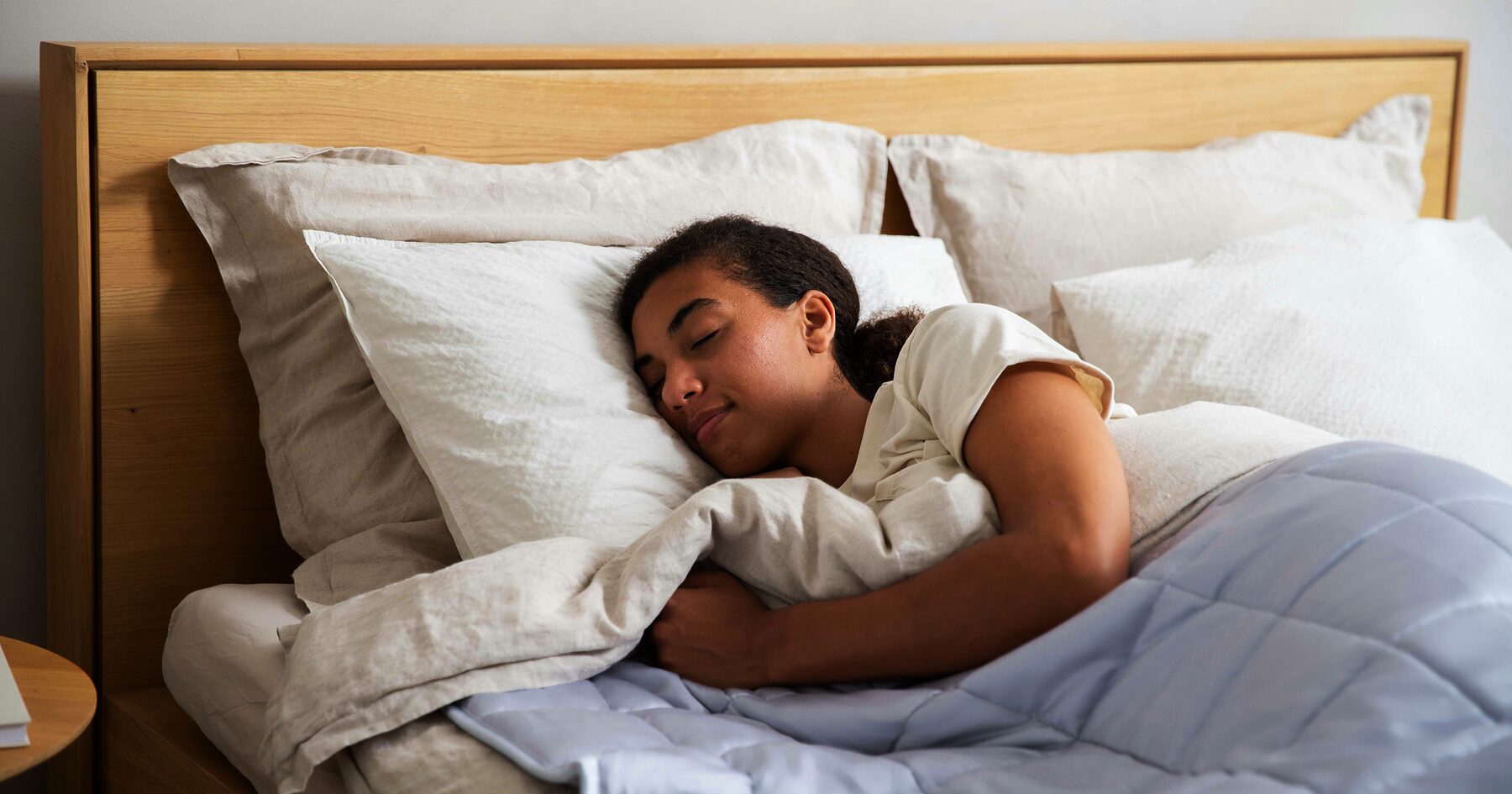
The advice always arrives as a list of a dozen habits, every one presented as equally proven. A few have controlled trials behind them; the rest sit between plausible and folklore, and nobody separates the two for you.
The short answer
Behaviour fixes ordinary bad sleep, not a sleep disorder.
What has real data is narrow: 400 mg of caffeine six hours before bed measurably disrupts sleep, and a 40–42.5 °C bath one to two hours before bed shortens time to fall asleep across 17 studies. But 30.5% of US adults sleep under seven hours and 18.1% can’t stay asleep most nights — for many the cause is a disorder no checklist reaches.
Key takeaways
- Light is the lever. After a week outdoors on natural light alone, the internal biological night shifted to begin at sunset.
- The evening-exercise ban is backwards. Across 23 studies, evening exercise slightly raised deep sleep.
- NIH puts caffeine’s reach at up to 8 hours: an 11 PM bedtime means a last cup between 3 and 5 PM.
- The famous 65–68 °F bedroom range has no guideline behind it. NIH says “cool” and stops.
Why the hours number misleads
Two people can each log eight hours and wake in different conditions. What separates them is sleep architecture — how much time lands in each stage, and how cleanly the body moves between stages.
Brief wakings and alcohol both fragment it while the tracker still reads eight hours. Only 54.8% of US adults wake rested most days, and plenty are in bed long enough. How many hours you need is a narrower question than it looks.
Light is the lever
The body clock takes its main cue from light, and the modern light diet is backwards: too dim in the morning, too bright after sunset.
A 2013 Current Biology study sent people camping. On natural light alone the internal clock resynchronised to solar time — biological night starting at sunset, ending just before waking. Late chronotypes advanced furthest: the most delayed clocks gain most.
You don’t need a campsite, just outdoor light early: indoor light is an order of magnitude dimmer than anything outside, even under cloud.
What holds up, and what doesn’t
| Habit | What the research shows | How solid |
|---|---|---|
| Morning outdoor light | Natural light alone resynchronised the clock to solar time; biggest shifts in late chronotypes | Strong mechanism |
| Caffeine cutoff | 400 mg at bedtime, 3 hours before and 6 hours before all disturbed sleep versus placebo — measured objectively, at home | Direct trial evidence |
| Warm bath or shower | 17 studies: 40–42.5 °C, 1–2 hours before bed, as little as 10 minutes, shortened time to fall asleep | Meta-analysed, thin literature |
| “No evening exercise” | 23 studies from 11,717 screened: evening exercise raised slow-wave sleep 1.3 percentage points and pushed REM latency out 7.7 minutes. Harm only for vigorous sessions ending ≤1 hour before bed | Contradicted |
Where the popular version overshoots
- “Morning light advances melatonin by 14 hours.” Light anchors the clock; it doesn’t schedule a hormone to the hour.
- “You’ll fall asleep 20–30 minutes faster within a week.” No trial produces that figure.
- “Half of people are slow caffeine metabolisers.” Clearance varies genetically and widely, but the 50% figure has no source.
- “65–68 °F is the ideal bedroom.” NIH says cool, dark and quiet, and attaches no number.
- The 4-7-8 breath, and “no food three hours before bed.” Harmless, unproven. NIH says avoid large meals several hours before sleeping; three is a round number.
Every “12 sleep habits” list — this one included — is not a therapy, and the field says so. The American Academy of Sleep Medicine’s 2021 guideline states that sleep hygiene should not be used on its own for chronic insomnia in adults. The single strong recommendation in that document is cognitive behavioural therapy for insomnia: structured, multi-week, clinician-led.
The 2013 caffeine trial opened with the same complaint — sleep hygiene advice is “widely disseminated despite the fact that few systematic studies have investigated the empirical bases” of it.
Build the evening, not the bedtime
A bedtime is one moment you hit or miss. An evening is a sequence, and sequences are easier to keep.
The last hour
NIH’s version is unglamorous: keep it quiet, dim the artificial light, skip vigorous activity, don’t work in bed. Which components you pick matters less than running the same ones in the same order — our evening routine is a workable template.
Caffeine and alcohol
NIH puts caffeine’s effects at up to 8 hours; the trial says 400 mg six hours out still disrupts sleep a monitor can see. For an 11 PM bedtime the last real cup lands between 3 and 5 PM — and feeling fine afterwards isn’t evidence it did nothing. More in caffeine and sleep.
Alcohol shortens sleep onset, then fragments the second half of the night. NIH says skip it before bed; the tidy “two drinks, three hours out” rule isn’t from a guideline.
Temperature
The most actionable finding here isn’t the thermostat — it’s the bath. Water at 40–42.5 °C, one to two hours before bed, for as little as 10 minutes, shortened time to fall asleep across the pooled studies, by pushing blood to palms and soles to dump heat. For the room: cool, dark, quiet.
When habits are the wrong tool
Some sleep problems are medical, and no amount of morning light touches them. See a clinician if any of this is you.
- Loud, chronic snoring plus daytime exhaustion. That points at sleep apnea, which carries cardiovascular consequences and goes unrecognised for years.
- Trouble sleeping three or more nights a week for more than three months — NIH’s line for chronic insomnia, and where CBT-I belongs.
- Unrefreshing sleep despite seven to eight hours in bed, sleepiness that affects driving, restless legs, or a mood change arriving alongside it.
- Pregnant, nursing, or on prescription medication and considering any sleep supplement, herbal included — clear it with your provider. Sedatives, blood thinners and antidepressants all interact.
Where to start tonight
Pick two. Twelve simultaneous changes leave you no way to tell which one did anything.
Start with outdoor light in your first waking hour and a caffeine cutoff you can keep. Track time to fall asleep, wakings, and how rested you feel out of ten; judge it at two to four weeks, not two nights. If you lose the thread at the same point each night, see the common mistakes and what shortens sleep onset.
Questions people ask
I’ve done all of this for a month and nothing changed. Now what?
Then habits weren’t the problem. That’s where the AASM guideline puts CBT-I — its only strong recommendation. Rule out apnea with a home sleep study too, especially if you snore or wake unrefreshed.
Can I catch up at the weekend?
Partly, and it costs you. NIH’s guidance is to hold bed and wake times inside roughly a one-hour window, weekends included. If Friday ran late, take morning light at the usual time and nap 20 minutes or less.
Is melatonin fine every night?
Long-term nightly use isn’t well studied, and shelf doses run far above what circadian research uses. Its strength is timing problems — jet lag, shift work, a clock running late — not insomnia. Full comparison here.
My partner snores. Whose problem is that?
Both. Loud habitual snoring with daytime fatigue is the classic apnea presentation and needs a clinician, not earplugs. White noise and separate bedding are a stopgap while the snoring gets looked at.
Sources
- Short Sleep Duration and Sleep Difficulties Among Adults: United States, 2024 — NCHS Data Brief 559, National Center for Health Statistics, 2026 (2024 data).
- Entrainment of the Human Circadian Clock to the Natural Light-Dark Cycle — Current Biology, 2013;23(16):1554–1558.
- Caffeine Effects on Sleep Taken 0, 3, or 6 Hours before Going to Bed — J Clinical Sleep Medicine, 2013;9(11):1195–1200.
- Before-bedtime passive body heating by warm shower or bath to improve sleep — Sleep Medicine Reviews, 2019;46:124–135.
- Effects of Evening Exercise on Sleep in Healthy Participants — Sports Medicine, 2019;49(2):269–287.
- Behavioral and psychological treatments for chronic insomnia disorder in adults — American Academy of Sleep Medicine, J Clin Sleep Med 2021;17(2):255–262.
- Healthy Sleep Habits — National Heart, Lung, and Blood Institute, NIH, 2022.
- Insomnia — What Is Insomnia? — National Heart, Lung, and Blood Institute, NIH, 2022.
How we make money. Some links on this page are affiliate links. If you buy through one, we may earn a commission at no extra cost to you. It does not change what we write — see our affiliate disclosure.
These statements have not been evaluated by the Food and Drug Administration. CBD products are not intended to diagnose, treat, cure or prevent any disease. Serene Leaf does not physically test products; our assessments are based on published research, third-party lab reports and publicly available product information.
This article is information, not medical advice. Talk to a qualified healthcare provider before starting any supplement — especially if you are pregnant, nursing, taking medication or managing a diagnosed condition. 21+ only.