
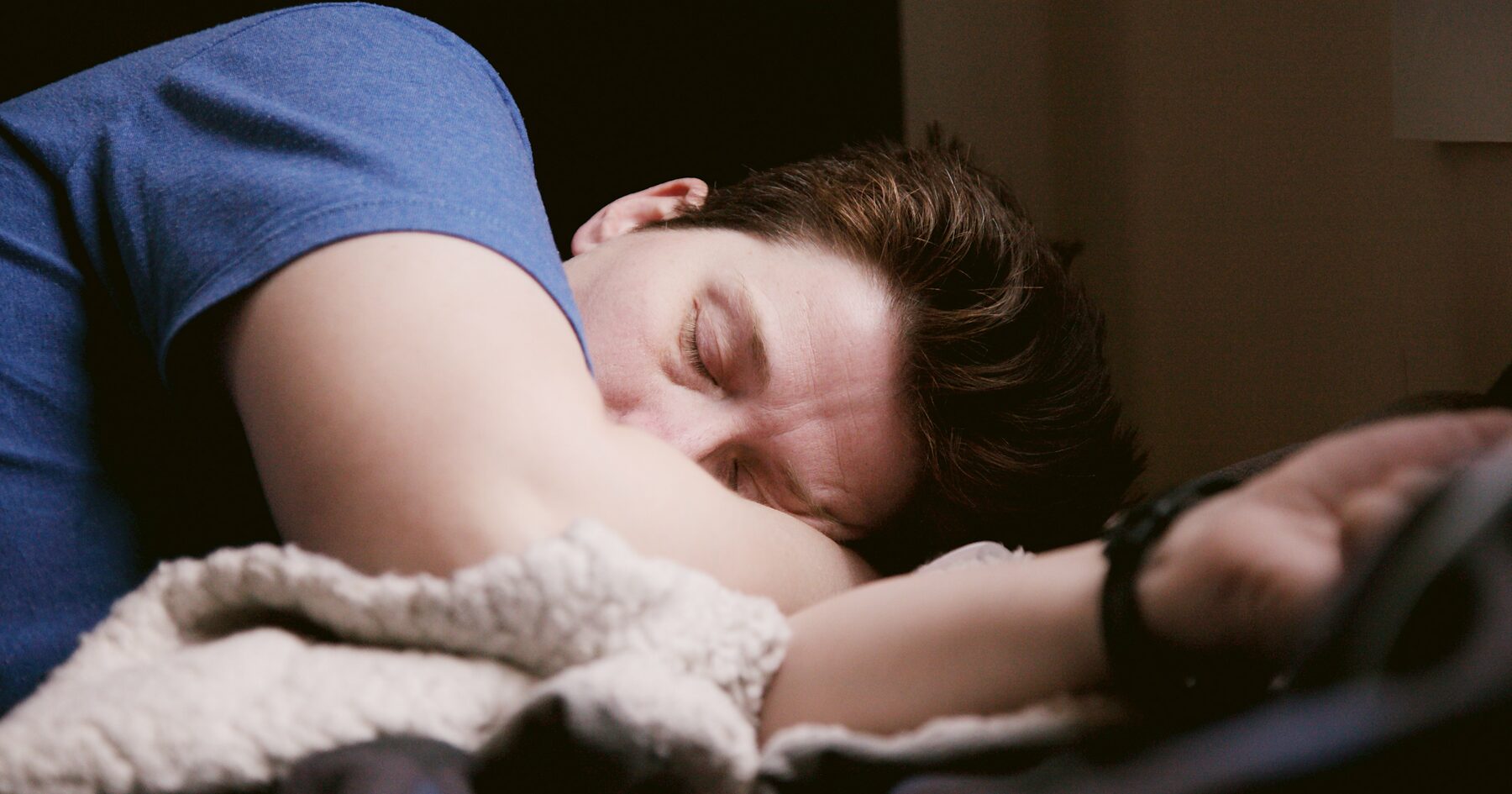
Nobody has shown that sleeping more than a normal night builds more muscle. What has been measured carefully is the other direction — what one night without it takes away.
The short answer
Yes — but the evidence only runs one direction.
In a randomised crossover trial, 13 healthy adults went one night without sleep and muscle protein synthesis fell 18% — 0.072 to 0.059 %/hour, p = 0.040. Cortisol rose 21%, testosterone dropped 22%, and IGF-1 didn’t move at all. That’s the cost of losing sleep, measured. The mirror image — banking extra sleep for extra muscle — has not been tested the same way.
Key takeaways
- The first cycles carry the repair. A cycle runs 80–100 minutes, four to six a night, with deep stage 3 concentrated early. Cutting the night short trims the wrong end.
- Cortisol is lowest around sleep onset and climbs through the later half — the early hours have the friendliest hormone balance.
- The alcohol story is backwards. A review of the published human studies found slow-wave sleep increased in the first half of the night at most doses. What alcohol wrecks is the second half.
- 400 mg of caffeine six hours before bed still measurably disrupted sleep against placebo.
Which hours do the work
The US National Heart, Lung, and Blood Institute puts one sleep cycle at 80 to 100 minutes, with four to six per night. The cycles aren’t interchangeable: stage 3 — deep, slow-wave sleep — is concentrated early, and REM stretches out later.
The hormones match. A 2019 study in the Journal of Clinical Endocrinology & Metabolism sampled free cortisol continuously in healthy men over 72 hours: lowest around sleep onset, rising through the later part of sleep, peaking near waking. So a 6am alarm on a midnight bedtime doesn’t shave a quarter off a uniform night. It removes a specific slice.
What one night off costs
Lamon and colleagues put 13 healthy young adults — 7 male, 6 female — through one night of total sleep deprivation and one normal night in randomised crossover order, then measured muscle fractional synthesis rate and hormones across the next day.
| Measure | After one night without sleep | Significance |
|---|---|---|
| Muscle protein synthesis | −18% — 0.072 to 0.059 %/hour | p = 0.040 |
| Plasma cortisol | +21% | p = 0.030 |
| Plasma testosterone | −22% | p = 0.029 |
| Plasma IGF-1 | No change | — |
The authors’ conclusion is the line worth keeping: a single night is enough to produce anabolic resistance and a pro-catabolic environment. One night, not a month of bad habits.
The IGF-1 result is the part the gym posters leave out. IGF-1 is the main downstream messenger of growth hormone, and it didn’t budge — the anabolic signal that moved was testosterone. The growth-hormone story is the popular mechanism, not the measured one, and this is a reminder of how thin the human data under it still is.
It’s also 13 people and one night. The direction is solid; read the exact percentages as a first estimate.
You’ll read everywhere that a nightcap destroys your deep sleep. The review of the published human studies says the opposite in the specific: at most doses, slow-wave sleep in the first half of the night went up. What alcohol reliably does is delay the first REM period at every dose and break up the second half. Still a bad trade for recovery — you just can’t blame it on lost deep sleep.
Protecting the early hours
- Move the last drink well before lights out. The damage lands in the back half, so the earlier it clears, the less of the night it takes.
- Six hours is the caffeine floor. In a controlled home study, 400 mg taken 0, 3 or 6 hours before bed each disrupted sleep against placebo; the authors’ own advice was a minimum six-hour gap. Detail in caffeine and sleep.
- Anchor the wake time. A fixed rise time keeps the early cycles landing at the same hour.
- Buffer a late session, and keep the room cool and dark — evening routines for recovery and the ideal bedroom.
The window narrows with age
A meta-analysis of 65 polysomnography studies covering 3,577 healthy people aged 5 to 102 found that in adults, slow-wave sleep, total sleep time, sleep efficiency and REM all decline with age while time awake after falling asleep rises. The recovery window shrinks at roughly the age sessions start taking longer to shake off — see stiffness and soreness with age.
When it isn’t just a bad week
- Anyone on prescription medication. Sleep supplements and hemp extracts compete for the liver enzymes clearing blood thinners, some antidepressants and seizure drugs. Ask a pharmacist before adding anything to a training block.
- Pregnant or nursing. Safety data across the sleep-supplement category is thin. Don’t self-experiment.
- Anyone whose broken sleep has run for weeks. A provider conversation, not a supplement one. The AASM’s one strong recommendation for chronic insomnia is multicomponent CBT-I — and the same guideline suggests clinicians not use sleep hygiene on its own.
- Anyone snoring, gasping, or waking unrefreshed after eight hours. Sleep apnea takes deep sleep apart night after night, and no recovery protocol compensates.
What to actually do
Do the free things first, in this order: fix the wake time, move the last drink and the last coffee earlier, give a late session an hour before bed. Four changes, no cost, all acting on the hours the trial says matter.
Only then is a supplement worth a thought, and a small one — our look at CBD for muscle recovery goes through how limited that evidence is. Nothing in a bottle outperforms the first two cycles of a full night.
Questions people ask
Can a nap make up for a short night?
Partly, and not for the thing this article is about. Naps have good evidence for alertness and perceived fatigue. Muscle protein synthesis hasn’t been tested the same way, so there’s no basis for saying a nap restores it. Think of one as damage control, not a swap for the night.
Should I train at all after a night like that?
You can, but the same session buys less adaptation in the state the trial describes, and coordination is worse — which matters most under a loaded bar. Drop the intensity, keep the habit, don’t chase a personal record on four hours.
How much sleep do I need for recovery?
Start from the standard adult target of seven or more hours and lean to the upper end during heavy training, since recovery demand rises with the load. Our guide to how much sleep you need covers what that target is and isn’t.
Why does soreness last longer after bad sleep?
The plausible explanation is what the trial measured: repair runs slower when synthesis is down and cortisol is up, so the same damage takes longer to clear. A mechanism that fits — not a proven cause of how sore you feel.
Sources
- The effect of acute sleep deprivation on skeletal muscle protein synthesis and the hormonal environment — Physiological Reports, 2021;9(1):e14660.
- Sleep Phases and Stages — US National Heart, Lung, and Blood Institute, NIH.
- Continuous free cortisol profiles — circadian rhythms in healthy men — Journal of Clinical Endocrinology & Metabolism, 2019;104(12):5935–5947.
- Alcohol and sleep I: effects on normal sleep — Alcoholism: Clinical and Experimental Research, 2013;37:539–549.
- Caffeine effects on sleep taken 0, 3, or 6 hours before going to bed — Journal of Clinical Sleep Medicine, 2013;9:1195–1200.
- Meta-analysis of quantitative sleep parameters from childhood to old age in healthy individuals — Sleep, 2004;27(7):1255–1273.
- Behavioral and psychological treatments for chronic insomnia disorder in adults: an American Academy of Sleep Medicine clinical practice guideline — Journal of Clinical Sleep Medicine, 2021.
How we make money. Some links on this page are affiliate links. If you buy through one, we may earn a commission at no extra cost to you. It does not change what we write — see our affiliate disclosure.
These statements have not been evaluated by the Food and Drug Administration. CBD products are not intended to diagnose, treat, cure or prevent any disease. Serene Leaf does not physically test products; our assessments are based on published research, third-party lab reports and publicly available product information.
This article is information, not medical advice. Talk to a qualified healthcare provider before starting any supplement — especially if you are pregnant, nursing, taking medication or managing a diagnosed condition. 21+ only.